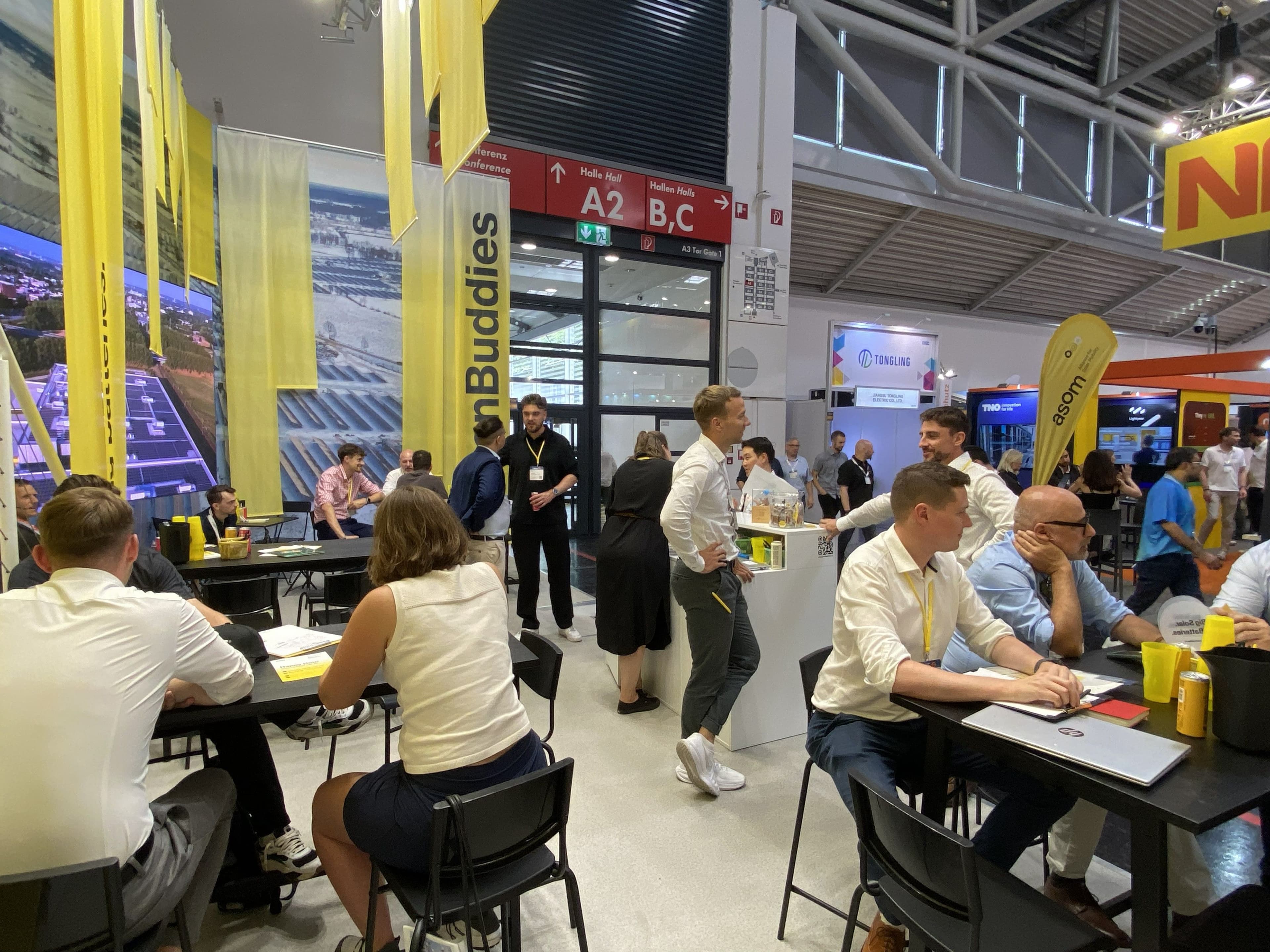
Unlike many companies on the show floor of Intersolar Europe 2026, we didn't come to launch a product. Our business is the construction of large-scale photovoltaic and battery storage projects all over Europe, so our booth served first and foremost as a platform for meetings with our partners. Over the three days, our team held around 140 pre-scheduled meetings with clients, investors and suppliers - by far our busiest Intersolar yet.
"Intersolar is the most important event of the year for our international business. We're expecting to strengthen long-term partnerships and build new ones. We also have a number of deals from recent months that we're looking to close," says Dan Štajner, Head of Sales at Greenbuddies.
Solar Energy, BESS, and Flexibility as the Foundation of the Future Energy Sector
This year's exhibition carried a confident, unified message from the industry: a reliable, around-the-clock energy supply built on solar, storage and smart grid management isn't a future aspiration, it's already technically and financially viable. The special exhibit Renewables 24/7 – Secure Energy for a Changing World illustrated this with practical scenarios on how decentralized generation, battery storage and flexible demand can balance the grid, while a new Fraunhofer ISE study backed it up with hard numbers on cost and resilience. Energy security featured heavily too, with several speakers pointing to Europe's 2022/2023 energy crisis as a reminder of how exposed import-dependent, fossil-based systems can be.
Technological Innovations for Large-Scale Solar Power Plants and Battery Storage Systems
A few specific technology trends stood out to us on the show floor. Huawei unveiled a new 500 kVA (500 kW) inverter, pushing past the previous ceiling of 330 kVA — a meaningful step for large-scale PV plants looking to cut the number of inverter units per project. We also saw a growing number of noise-barrier solutions designed specifically for battery storage, making it easier to site BESS installations close to residential areas without disturbing neighbors. And sodium-ion batteries are clearly moving from concept to practice: several exhibitors showed real, deployable products aimed at large-scale storage, a technology worth watching closely in the next few years.
We also noticed a flood of low-cost technology on the market, often at the expense of quality, reliability and safety. AI was present almost everywhere this year too, from production and consumption forecasting to battery management, panel diagnostics and predictive maintenance. And another trend worth flagging: a growing number of module and inverter manufacturers are now building their business specifically around being non-Chinese, as an alternative to the dominant Chinese supply chain.
The smarter E Europe as a platform for partnerships and new projects
For us, these are exactly the themes we work with on our projects every day - grid flexibility, battery storage and resilient, decentralized infrastructure are no longer optional extras, they're what the energy system of the future is being built on.
We're already looking forward to following up on the conversations started in Munich, and to being back at The smarter E Europe next year.